All posts by Neetu Singh

Write short notes on the Realism

Realism is a posture that assumes the constitutive autonomy of different phenomena in relation to our ability to understand them, and the reliability of our understanding in apprehending them correctly. Realism can be ontological (relating to a fundamental belief that cannot be demonstrated) or epistemological (and as such considered to be the only correct manner of scientific undertakings: confronting things as they exist, independently from our own volition). This means that realism requires a degree of confidence in the reliability of our openings onto the world (our sensory experience, report by others, scientific measures). Thus positivism can be said to be a form of realism that casts doubt on immediate experience and our spontaneous categorisations, tending to integrate these into protocols that aim to extract explicative relationships or laws from reality, these being the only objects worthy of being targeted by science.

Realism is the view that reality exists independent of the mind; it is not mind dependent. It is antithetical in many respects to idealism. Gibson suggests realism as a viable alternative explanation to idealism. The basic philosophy of realism is that facts speak for themselves and explanation is logical and inductive. Realism advocates the use of theories and models in geographical explanation. It is very close to the objective philosophy of positivism but has different methodology of explanation.

Historically, realism by the Platonic-Socratic thought was used in opposition to nominalism” for the doctrine that universal and abstract entities have real objective existence. At present, it is, however, used in opposition to idealism. In contrast to other philosophies of science such as naturalism, positivism, and idealism, realism is based on the doctrine that human science is an empirically-based rational enterprise which explains observable regularities by describing the hidden, but ‘real’ structures that casually generate them.

In his theory of ideas, Plato asserted that the forms we see, touch, taste and smell in time and space do not exist and are not knowable with our senses. A particular phenomenon is only appearance which shall disappear in due course of time.

For example, a specific mountain like the Himalayas does not exist, it will be worn down to the ocean floor over geological time. Contrary to this, the general and universal term ‘mountain’ is rigid and fixed. Just opposite to it, the nominalists, notably, Aristotelians denied the existence of an ideal mountain. For the early nominalists ‘mountain’ was a mere term. What is real is a particular mountain that we can all see and touch.

The battle between the realists and nominalists over the existence of abstract entities of problematic entities, carried over the medieval period. During the medieval period, the Platonic-Socratic thought came to be known as scholastic realism. The main proponent of scholastic realism was John Scot.

In the 19th century, ‘realism’ took the shape of ‘direct’ or ‘naive’ realism which was a polemic against idealism. Cook Wilson was the founder of ‘naive realism’. He and his pupils denied the existence of any problematic or abstract entity—a denial which of course runs counter to Plato. For direct realist:

Nothing existed that was not observable in time and space. From this ontology they developed a logic of perceiving the world, a common-sense logic which argued that our views of the world are constructed in the mind by an interaction, through society, with the physical world.

This direct naive realism has had a sustaining influence on geography, especially on commercial and military geography, since the Victorian period. For the naive or common-sense geographers, the mind grasps the world in a simple effortless process, something we do all the time.

Geographical facts of observed phenomena and changes within them can be objectively established and any question of unseen entities, problematic, abstract forms or subjective impressions is irrelevant. With due precautions, by simple common-sense, we can know the reality of a place, as the topography looks, as the soil feels, as the water tastes, etc. The objectives of ‘naive realism’ are common to those social reform to or national surveys. Stamp, with this objective, conducted the land use survey of Britain and suggested significant changes in the utilization of land.

It gave more job opportunities and greater respectability to geographers. The sixties can be called as a period of extreme of naive realism, which has also been termed as a phase of ‘quantitative revolution’ in geography. This revolution was based mainly on a move toward philosophical ‘positivism’.

Realism has taken the shape of ‘new or critical realism’ in the last few decades. It was propounded by T.P. Nunn. The essence of the concept of new realism is that anything we experience depends for its existence upon the fact that it is experienced. In other words, the objects of our perception are actual properties of the physical world. The proponents of this philosophy asserted that nothing exists excepting that which is experienced.

What is radical approach in Geography? | Human Geography

 What is radical approach in Geography?

Ans. The radical approach in geography developed in 1970s as a reaction to ‘quantitative revolution’ and positivism which tried to make geography as a spatial science, with great emphasis on locational analysis.

The followers of radical approach in geography mainly concentrated on the issues of great social relevance like, inequality, racism, sexism, crime, delinquency, discrimination against blacks and non-whites, females, exploitation of juveniles and environment resources and the opposition of the Vietnam war in U.S.A. Events of the late 1960s, such as the burning of large cities in the western world, student-unrest, worker-uprising in Paris in 1968, massive anti-Vietnam war protest actions and radical cultural reformation exposed the social and political irrelevance of geography as a spatial science and proved the hollowness of locational analysis.

It was in this background that the radicalized students and junior faculty members challenged the traditional geography (geography as spatial science) and they started publishing articles with more ‘socially relevant’ geographic topics in the professional journals. In 1969, Antipode—a Radical Journal of Geography was founded at the Clark University in Worcester (Massachusetts), specifically to publish the research papers of the younger geographers with a revolutionary leaning.

The young radical geographers published papers in Antipode dealing with urban poverty, discrimination against women, colored people and minority groups, unequal access to social amenities, crimes, deprivation, permissiveness and sexism. They also published articles on underdevelopment, poverty, malnutrition, and unemployment and resource misuse in the Third World countries. Thus, the radicalists took the side of the oppressed, advocating their causes and pressing for fundamental social change. In brief, the radical geography was a quest for social relevance of the discipline geography at a time of contradiction and crises in the capitalistic society of the west.

The origin of the radical geography movement can be traced to the in late 1960s, especially in the U.S.A. with three contemporary political issues: The Vietnam war, Civil rights (especially of the American blacks), and The pervasive poverty and inequality suffered by the residents of urban ghettos and deprived rural areas all of which were generating increased social unrest and tension. In the words of Peet (1977), radical geography developed largely as a negative reaction to the established discipline (spatial science). The radical geographers introduced the study of topics such as poverty, hunger, health, and crime to human geographers, who had previously very largely ignored them.

The salient features and objectives of radical geography were:

  • To expose the issues of inequality, deprivation, discrimination, health, exploitation, crime and environmental degradation in the capitalist countries.
  • To highlight the weaknesses of the positivism and quantitative revolution in geography which emphasized on geography as a ‘spatial science’ with a thrust on locational analysis.
  • To bring a cultural revolution to eradicate permissiveness, sexism and discrimination against females.
  • To remove regional inequalities.
  • Radicalists opposed political centralization and economic concentration. Contrary to multinationals, they favoured small- scale self sufficient social units, living in greater harmony with their natural surroundings.
  • They were against imperialism, nationalism, national chauvinism and racism.
  • They opposed the idea of the superiority of the white and the west.
  • According to radicalists the man and environment relationship may be understood through history. In other words, the mode of production in any society determines the economic relation among its people.
  • One of the objectives of the radicalists was to explain not only what is happening but also to prescribe revolutionary changes and solution to the social problems.

Best Optional Geography Coaching for IAS : How to decide the best institute for UPSC

Choosing the right optional coaching is one of the most critical decisions in your UPSC journey, especially for a vast and semi-scientific subject like Geography. Neetu Singh Ma’am (Direction IAS) is undeniably one of the most respected and established names in this field.

To help you decide if her institute is the best fit for you, let’s break down the general framework for choosing a Geography institute, followed by an objective look at her teaching style, strengths, and areas where you might need caution.

The 4-Pillar Framework to Decide on a Geography Institute

Before committing your time and money to any coaching center, evaluate them against these four criteria:

  1. Pedagogy (Teaching Style): Does the teacher explain complex concepts (like geomorphology or climatology) from scratch, or do they assume you already have a geography background?

  2. Syllabus Coverage: Is the entire syllabus completed systematically? Pay close attention to Paper 2 (Indian Geography), which needs constant integration with current affairs.

  3. Answer Writing & Evaluation: Does the core faculty evaluate your answers and provide personal feedback, or is it outsourced to a team of content writers?

  4. Study Material: Are the class notes comprehensive enough to replace heavy textbooks, or will you still have to juggle multiple references?

Deep Dive: Neetu Singh Ma’am (Direction IAS)

Neetu Singh Ma’am has been mentoring civil services aspirants for over two decades. Her institute, Direction IAS, focuses heavily on a disciplined, comprehensive approach.

The Pros (Why Aspirants Choose Her)

  • Single-Faculty Ownership: Unlike institutes where 2–3 different teachers split the syllabus, Ma’am covers 100% of the syllabus herself. This ensures a seamless thematic flow between Physical, Human, and Indian Geography.

  • Exceptional Foundations & Mapping: She is highly praised for building concepts from the absolute ground up. Her command over mapping and physical geography makes it incredibly easy for students—even those from non-science backgrounds—to grasp tough topics.

  • Exhaustive Classroom Dictation: Her methodology involves thoroughly explaining a topic and then dictating detailed notes. For students who struggle with note-making, her classroom dictation acts as a definitive reference.

  • Highly Approachable: Student feedback consistently highlights that she is accessible for doubt-clearing and personal mentorship. She actively reviews answer scripts and guides students on where they are lacking.

The Cons / Things to Keep in Mind

  • Pace and Volume: Because she covers the syllabus comprehensively, the sheer volume of dictated notes can feel overwhelming. Keeping up with her pace in class requires intense focus.

  • Human Geography Analytics: While her foundational lecturing is top-tier, some aspirants note that the highly dynamic sections of Human Geography and contemporary Paper 2 issues require extra effort and current affairs integration from your end.

  • Class Context is Mandatory: Buying her handwritten notes from the market without attending her lectures can be confusing. Her material is designed to complement her verbal explanations, not necessarily to stand alone as a self-study textbook.

Market Comparison: Notable Alternatives

To make an informed choice, it helps to see how she compares with other highly rated Geography faculty in the UPSC ecosystem:

Faculty & Institute Core Strength Teaching Style
Neetu Singh Ma’am  Comprehensive coverage, mapping, foundational clarity, and heavy dictation. Traditional, exhaustive, teacher-led, excellent for beginners wanting structured notes.

2025 UPSC Main- Thought Question

How have dichotomy and dualism affected the methodological development of Geography? Describe.  

Dichotomy and dualism have been both divisive and productive forces in Geography. While they initially led to fragmentation and methodological divides, they also:

  • Encouraged specialization
  • Stimulated debates and paradigm shifts
  • Ultimately pushed the discipline toward integration and methodological pluralism

While dualism and dichotomy often appear together in Geography, they serve different roles. Dualism is philosophical and interpretative, shaping methodological approaches, whereas dichotomy is structural and organizational, helping classify the discipline. Together, they have influenced both the intellectual foundations and the methodological development of Geography.

Overall Influence on Methodological Development

Specialization and Fragmentation Dualisms divided geography into subfields with distinct methods, leading to depth but also fragmentation.

Methodological Innovation Each side of a dichotomy developed its own tools:

Natural science methods (experiments, remote sensing)

Social science methods (surveys, participatory research)

Debate and Intellectual Growth Conflicts between opposing approaches stimulated critical thinking and paradigm shifts.

Major Dualism & Dichotomies with Methodological Impact

  1. a) Physical vs Human Geography This is the most prominent dualism.

Physical Geography focused on natural processes (geomorphology, climatology), adopting methods from natural sciences—observation, measurement, modeling.

Human Geography studied human activities, culture, and society, using social science methods—surveys, interviews, qualitative analysis.

  • Led to specialization and methodological divergence.
  • Created separate research traditions and tools.
  • Later encouraged integrative approaches like environmental geography and sustainability studies.
  1. b) Regional vs Systematic Geography

Regional Geography: Studies specific areas holistically (idiographic approach).

Systematic Geography: Studies particular phenomena globally (nomothetic approach).

  • Regional geography relied on descriptive, field-based, and synthetic methods.
  • Systematic geography promoted analytical, comparative, and theory-building methods.
  • This dichotomy led to debates about whether geography should describe unique places or develop general laws.
  1. c) Determinism vs Possibilism

Environmental Determinism: Environment controls human actions.

Possibilism: Humans have agency and can modify the environment.

  • Determinism encouraged causal, often simplistic environmental explanations.
  • Possibilism introduced more nuanced, human-centered, and interpretative methodologies.
  • Helped shift geography toward social theory and cultural analysis.
  1. d) Quantitative vs Qualitative (Positivist vs Humanistic)

Quantitative/Positivist: Uses statistics, models, spatial analysis (e.g., spatial science revolution).

Qualitative/Humanistic: Focuses on perception, experience, and meaning.

  • The quantitative revolution (1950s–60s) introduced mathematical models, GIS, and hypothesis testing.
  • Reaction to it led to behavioral, radical, and humanistic geographies using interviews, ethnography, and critical theory.
  • Ultimately broadened methodological pluralism.

Today, Geography is best understood as a bridging discipline that synthesizes natural and social sciences, moving beyond rigid dualisms toward a more holistic understanding of space, place, and environment.

  • Emergence of interdisciplinary fields (e.g., human–environment interactions, GIS)
  • Adoption of mixed methods (quantitative + qualitative)

India’s record Foodgrain production

Foodgrain production rises to 357.73 million tonnes in 2024-25, up from 332.30 million tonnes in 2023-24

Agriculture Minister stated that rice production has also reached a record level of 1,501.84 lakh tonnes, which is 123.59 lakh tonnes higher than last year’s 1,378.25 lakh tonnes. Wheat too has registered record growth, rising to 1,179.45 lakh tonnes, an increase of 46.53 lakh tonnes over last year’s 1,132.92 lakh tonnes. Moong production has increased to 42.44 lakh tonnes, soybean to 152.68 lakh tonnes, and groundnut to 119.42 lakh tonnes. Maize and ‘Shri Anna’ (millet) output are estimated at 434.09 lakh tonnes and 185.92 lakh tonnes, respectively, compared to 376.65 lakh tonnes and 175.72 lakh tonnes, respectively, last year.

Expressing satisfaction over the strong rise in oilseed production, the Union Minister said that total oilseed output during 2024-25 is estimated at a record 429.89 lakh tonnes, which is 33.20 lakh tonnes higher than the 396.69 lakh tonnes produced in 2023-24. The increase is driven by record groundnut and soybean output, estimated at 119.42 lakh tonnes and 152.68 lakh tonnes respectively. These represent increases of 17.62 lakh tonnes and 22.06 lakh tonnes over last year’s 101.80 lakh tonnes and 130.62 lakh tonnes. Rapeseed and mustard output is estimated at 126.67 lakh tonnes.

presented crop-wise details as follows:

Total foodgrains – 3,577.32 lakh tonnes (Record)

● Rice – 1,501.84 lakh tonnes (Record)
● Wheat – 1,179.45 lakh tonnes (Record)
● Nutri/Coarse Cereals – 639.21 lakh tonnes
● Maize – 434.09 lakh tonnes
● Total Pulses – 256.83 lakh tonnes
● Shri Anna (millet) – 185.92 lakh tonnes
● Chickpea – 111.14 lakh tonnes
● Moong – 42.44 lakh tonnes
● Tur – 36.24 lakh tonnes
Total Oilseeds – 429.89 lakh tonnes

● Soybean – 152.68 lakh tonnes (Record)
● Groundnut – 119.42 lakh tonnes (Record)
● Rapeseed & Mustard – 126.67 lakh tonnes
Sugarcane – 4,546.11 lakh tonnes
Cotton – 297.24 lakh bales (170 kg each)
Jute and Mesta – 88.02 lakh bales (180 kg each)

Himalaya is a global biodiversity

The Himalaya is a global biodiversity hotspot covering parts of Nepal, Bhutan, China, and India’s Northeast, renowned for its incredible plant and animal diversity, especially endemic species. This region features extreme elevation changes, creating diverse ecosystems from subtropical forests to alpine meadows and is home to threatened species like tigers, snow leopards, and the

Red Panda.

  • Mammals: Home to iconic and endangered species such as Asian Elephants, Tigers, Snow Leopards, and the Red Panda.
  • Birds: Includes the vulnerable Great Hornbill and White-bellied Heron.
  • lants: Hosts an estimated 9,000 plant species, with about 3,500 being endemic and holding medicinal properties.

    The Western Ghats form a part of Western Ghats-Sri Lanka global biodiversity hotspot.

    They run parallel to the west coast of India and run across the states of Maharashtra, Goa, Karnataka, Tamil Nadu and Kerala. Locally they are also known as the Sahyadris.

    Out of the 5584 indigenous species of plants, 2242 species are endemic to India and 1261 are endemic to the Western Ghats endemics.

    The Western Ghats is also rich among the invertebrate groups.

    • About 350 ant species, 20% of which are endemic to this region.
    • 330 butterfly species, 11% of which are endemic to this region.
    • 174 odonate species that includes dragonflies and damselflies, 40% of which are endemic to this region.
    • 269 mollusc species that includes land snails, 76% of which are endemic to this region.
    • The fish fauna of the Western Ghats spans around 288 species, 41% of which are endemic to this region.
    • The amphibian fauna of this region consists of 220 species, of which 78% are endemic.
    • 62% of the 225 described species of reptiles found here, are endemic to this region.

    Over 500 species of birds and 120 species of mammals are also known from this region.

    • Key species: Home to endangered species like the Nilgiri Tahr and Lion-tailed Macaque.

    The Western Ghats region harbours the largest global populations of the Asian elephants and possibly of other mammals such as the tiger, dhole and gaur. Wild relatives of cultivated plants are also found here, including pepper, cardamom, mango, jackfruit and sandal.

    The North-East forms a part of Indo-Burma global biodiversity hotspot.

    Some parts of the north-eastern region of India, excluding the Himalayan region, form a part of the Indo-Burma biodiversity hotspot.

    • It is centred on the Indo-Chinese Peninsula, and comprises of Cambodia, the Lao People’s Democratic Republic, Myanmar, Thailand, Vietnam and parts of Southern China.
    • More than 60% of the bird species found in India have been recorded in the North-East.
    • It harbours 35 endemic reptilian species including two genera of lizards and two turtle species.
    • Out of 341 Indian amphibian species, at least 68 species are known to occur in the North-East. 20 out of the 68 are endemic.
    • It is enriched with 13,500 vascular plant species, of which about 7000 (52%) are endemic to North-East.
    • 74 out of the 1277 bird species found in Indo-Burma are endemic to North-East.
    • 71 of the 430 mammal species in the hotspot are endemic to this region.
    • 189 of the 519 non-marine reptile species are endemic to this region.
    • 139 of the 323 amphibian species are endemic to the hotspot.
    • It also supports a high diversity of freshwater turtles.
    • It also accounts for about 10% of the fish fauna in the world. 566 out of the 1262 documented fish fauna species are endemic to this region.

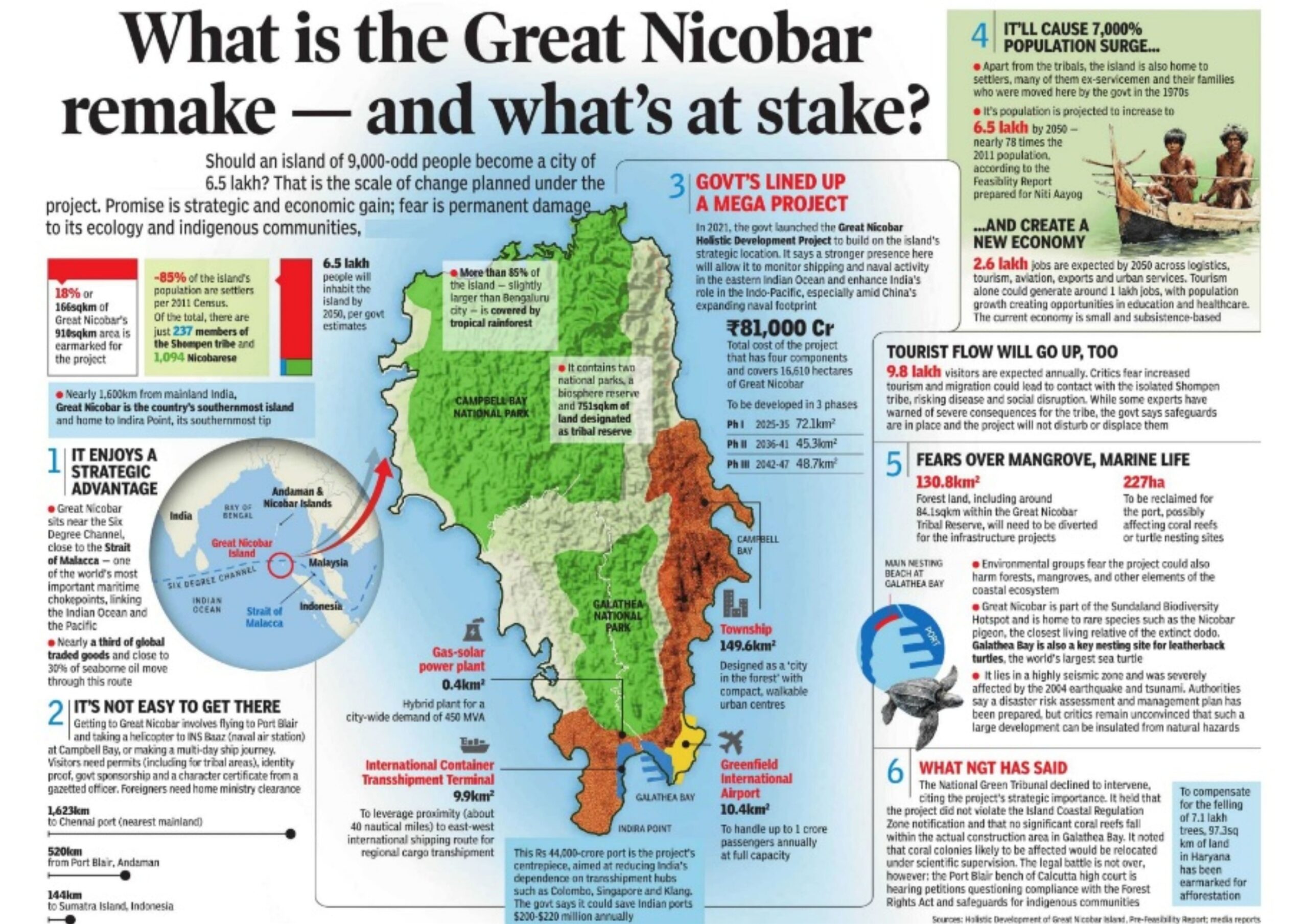
    Nicobar Islands are a part of the Sundaland global biodiversity hotspot.

    • Mangrove forests are found in these islands.
    • 3500 plant species are found in the Andaman and Nicobar group of islands.
    • Out of these 3500 species, 422 of floral genera and 648 species are endemic to the Nicobar Island.
    • Out of the 120 pteridophyte species of the Andaman and Nicobar Islands, 50% are from Great Nicobar Island alone.
    • A total of 110 wild orchids are reported from these islands, of which 19 genera, with 25 species, are endemic.

    The Malayan box turtle, the Sunbeam snake, the Saltwater crocodile and the Reticulated python are found in the Southern Nicobar group, besides several species of Pit viper in the central Nicobars.

    15 reptile species are reported to be endemic to the Nicobars.

    Four species of marine turtle, the Leatherback turtle, Hawksbill turtle, Green sea turtle and the Olive ridley turtle feed and nest around the Andaman and Nicobars. The nesting population of Leatherbacks in the Nicobars is one of the last four colonies that exceed 1000 individuals in the Indo-Pacific and hence has global significance.

    https://youtu.be/zoXsohPDVZc

Biodiversity

Biodiversity is the variety of life on Earth, encompassing the diversity of species, genetic variations within those species, and the ecosystems they form. It is a term that includes all living organisms, from plants and animals to microorganisms, and the complex interactions between them and their habitats.

Species diversity: The variety of different species in a given area, from the number of species to their relative abundance.

Genetic diversity: The variation of genes within a single species, which is crucial for adaptation and survival.

Ecosystem diversity: The variety of different ecosystems in a geographical area, such as forests, wetlands, and deserts.

There are an estimated 8.7 million species on Earth, though only about 1.2 million have been scientifically described and cataloged. Insects are the most numerous described group, followed by birds, reptiles, and mammals

There are three high-level habitat environments: land, marine, and deep subsurface environments. Deep subsurface environments can be terrestrial or below the ocean floor, but represent habitats deep below the surface – extending from around 50 metres to thousands of metres below the surface


Most of life exists on land 86% of biomass.

  • This is because almost all plant life – mostly trees – is terrestrial. The marine plants, for example seaweed, make up less than 1 billion tonnes of carbon. This is less than 0.2% of total plant biomass.
  • Most bacteria and archaea exists in the deep subsurface, meaning 13 percent of global biomass thrives in this environment.
  • Despite dominating our planet in terms of area and volume – taking up more than 70% of global surface area – the oceans are home to just 1% of biomass.

But they do dominate the animal kingdom: 78% of animal biomass lives in the marine environment.

Geography Optional Syllabus UPSC 2026

Overview of the Geography Optional Syllabus for UPSC

The Geography Optional syllabus for the UPSC examination is both comprehensive and intellectually stimulating, encompassing a wide range of topics from physical to human geography. It aims to equip aspirants with a holistic understanding of the Earth’s systems and the intricate relationship between humans and their environment.

1.Geomorphology: Factors controlling landform development; endogenetic and exogenetic forces; Origin and evolution of the earth’s crust; Fundamentals of geomagnetism; Physical conditions of the earth’s interior; Geosynclines; Continental drift; Isostasy; Plate tectonics; Recent views on mountain building; Vulcanicity; Earthquakes and Tsunamis; Concepts of geomorphic cycles and Landscape development ; Denudation chronology; Channel morphology; Erosion surfaces; Slope development ; Applied Geomorphology : Geohydrology, economic geology and environment.

  1. Climatology: Temperature and pressure belts of the world; Heat budget of the earth; Atmospheric circulation; atmospheric stability and instability. Planetary and local winds; Monsoons and jet streams; Air masses and front genesis, Temperate and tropical cyclones; Types and distribution of precipitation; Weather and Climate; Koppen’s, Thornthwaite’s and Trewartha’s classification of world climates; Hydrological cycle; Global climatic change and role and response of man in climatic changes, Applied climatology and Urban climate.
  2. Oceanography: Bottom topography of the Atlantic, Indian and Pacific Oceans; Temperature and salinity of the oceans; Heat and salt budgets, Ocean deposits; Waves, currents and tides; Marine resources: biotic, mineral and energy resources; Coral reefs, coral bleaching; sea-level changes; law of the sea and marine pollution.
  3. Biogeography: Genesis of soils; Classification and distribution of soils; Soil profile; Soil erosion, Degradation and conservation; Factors influencing world distribution of plants and animals; Problems of deforestation and conservation measures; Social forestry; agro-forestry; Wild life; Major gene pool centers.
  4. Environmental Geography: Principle of ecology; Human ecological adaptations; Influence of man on ecology and environment; Global and regional ecological changes and imbalances; Ecosystem their management and conservation; Environmental degradation, management and conservation; Biodiversity and sustainable development; Environmental policy; Environmental hazards and remedial measures; Environmental education and legislation.

The journey begins by highlighting the critical importance of a well-defined strategy. With an extensive syllabus that spans physical, human, and regional geography, a clear plan is essential to maximize efficiency and ensure thorough coverage of all key areas. Geography has emerged as the most popular optional subject among candidates preparing for competitive examinations, particularly the UPSC Civil Services Mains.

Why Geography Optional is i am not from Geography Background.

Geography Optional the study of is about more than just memorizing places on a map. It’s about understanding the complexity of our world appreciating, the diversities, and in the end, it is about using all that knowledge to crack Optional and GS requirement.

Technically the content matter of Geography has three approaches, viz.

  • Theoretical –Geographical Thought and Physical Geography build up the theoretical and ideological foundations of Geography.
  • Methodological – Methods applied for Geographic studies i.e. integration of content matter to strengthen the methodological and quantitative foundations of Geography.
  • Systematic Approach –Environment and Ecology, Human Geography address the contemporary issues in Geography

Geographers strive to understand Earth’s surface and the processes that shape it, the links between humans and the natural environment, and the spatial linkages among humans and their activities. The geographer is concerned with the how, why, and where of these reciprocal relationships.

Geography Optional paper—a fact clearly reflected in the data provided in the table. The comprehensive and interdisciplinary nature of Geography makes it a powerful subject for those who approach it with a well-crafted strategy and the benefit of expert insights.

For the last 23 years Geography Optional has proved to be the most selected and most successful optional. Our Top Ranks : 2010 (Pulkit) AIR 5th, 2011 (Sundraj) AIR 5th, 2012 (Arun) AIR 6th, 2013 (Chanchal Rana) AIR 7th, 2014 (Suharsha) AIR 5th 2015 (Vipin Garg) AIR 20th, 2016 (Samuya) AIR 4th, 2017 (Pratham) AIR 5th, 2018 (Girdhar) AIR 61th 2019 (Gunjan Singh) AIR 16th 2020 (Ashiware Verma) 2021 AIR 4th (Muskan Srivastava) AIR 98 (Shivang Srivastava) AIR 102 Best Geography Institute for civil services examination.
Highest Marks in this Institute in UPSC

The Geography Optional Topper scored 306 marks out of 500(AIR 12) 2021 YASHARTH SHEKHAR.

The Geography Optional Topper scored 327 marks out of 500 AIR 5 2017 PARTHAM KAUSHIK.

Nature of Questions in Geography Optional

  • The first area of inquiry is how to understand and respond to environmental change.
  • How are we changing the physical environment of Earth’s surface?
  • How can we best preserve biological diversity and protect endangered ecosystems?
  • How are climate and other environmental changes affecting the vulnerabilities of human—environmental systems?

The second area of inquiry is how to promote sustainability.

  • How and where will 10 billion people live?
  • How will we sustainably feed everyone in the coming decade and beyond?
  • How does where people live affect their health? Added to this question is how the inter connections of people affects health—particularly in the context of regional and global health epidemics.

The third area of inquiry is how to recognize and cope with the spatial reorganization of economy and society.

  • How is the movement of people, goods, and ideas transforming the world?
  • How is economic globalization affecting inequality?
  • How are geopolitical shifts influencing peace and stability?

Urban Morphology Theories

  • Apart from these theories of urban growth and process of decay there are some models of urban growth & its pattern of landuse in the form of different theories. These include concentric zone theory or concentric ring theory, Axial Development theory, Sector theory and multiple nuclei theory. These theories of urban development patterns are quite important in landuse planning. Because in landuse planning process the main focus is on conversion of individual parcels of land from rural to urban uses and the role of public and private sector in that conversion.
    These theories are an attempt to understand and explain that how an urban area grows and what landuse changes occurs in it. it describes the basic urban structure of a city & dynamics of urban growth in town or city.
    Concentric Zone / Ring Theory:
    The concentric zone theory is based on the pioneering work of Ernest. W. Burgess who have carried out the empirical studies of Chicago and developed the concentric Rings theory. He identified five zones of landuse in the city. The figure developed by him shows the typical process of urban growth by five numbers of concentric circles which emerged & expands form CBD.
    The fist concentric circle of central business District (CBD) represents the center of activity generally close to the site of original settlement. The concentric circle means that some thing which converges to a focal factor. For example if we think of a smaller community the house of a land lord will be the focal point or in ancient or medieval time the palace of king & temple was a focal point in city. Like wise in this theory CBD is that focal point of an urban area. It also represents the old town areas or origin of city which has a central position in expansion.
    The second concentric circle represents the transition zone which consists of mix commercial and industrial land uses. It means the areas around CBD are subject to changes and transformations in which the old residences transform into business and industrial landuse. Such as wholesaling and warehousing activities.
    The third zone represents the landuse of low income housing in metropolitan area which contains old housing units or housing of workers of CBD. It is developed due to easy access to job or working area proximity to place of living.
    The fourth zone represents a middle income housing zone that includes some of the old suburbs. In this zone good residential facilities are evident for high income group where as this zone also comprise exclusive districts for high income people.
    The fifth and final zone is of newer suburban developments or commuters who use the fastest transport routes. This zone consists of high class residences and the outer limit of this zone has one hour journey to CBD. If one analyze this model of given pattern and growth situation it will be evident that, each zone held to invade the outer adjacent zone with a rippling effect. With decline enlarges intro central zone. The basic concept of this theory is that similar activities will locate at the same distance from the center of an urban area. The landuse in each zone depends upon its ability to pay the price for proximity to city center or CBD. In this growth model each zone would have a homogeneous landuse as the physical growth proceed outward from the center and the area occupied would have similar characteristics. From economic point of view the concentric zone is only possible when the site of growth will be located equidistant from center irrespective of direction. According to this theory the process of urban growth is of radial expansion from city center. Although this model is very simple but it has a certain description value.
    Axial Development Theory:
    The axial development theory is a continuation of concentric zone theory because its basic premise is same i.e. accessibility to a single focal point. However in this theory the accessibility is measured in terms of time and physical distance and focus is given to transport facilities in an urban area. This theory explains that as the movement will be concentrated along a particular route therefore development also takes place on this route. Thus urban expansion can be controlled by available transport facilities. It is an extension of each landuse type will develop along major transport route and as a repercussion star shape pattern of landuse will occur in urban built up area. Where as the number of arms of star depends upon the major transport routes in a city.
    The limit to this development along main transport routes is set through the area development closer to center with less distance to center. Therefore basically this theory explains about the shape of urban built up areas by introducing some transport routes in addition to peripheral expansion by transport radials. And in this kind of development the pattern of internal landuse will be of irregularly shaped zones.
    Sector Theory: 
    The sector theory is the refinement of both axial development theory and concentric zone theory. The sector theory was first proposed by Homer Hoyt in 1939. In this theory the focus of attention is a particular landuse growth & development. It suggests the cities grow not in strict concentric zones but rather in sectors similar type of development. This theory explains that the growth takes place along a particular axis of transport route with mainly similar type of landuse. Each sector consist a homogeneous landuse which expands outward in a particular direction away from the CBD. The residential areas might expand along with existing transportation links, topographical features or natural amenities such as Chicago’s gold cost and north suburbs clearly show this pattern.
    Thus the major attempt of sector theory is to explain the pattern of urban growth from the view point of residential landuse changes. According to sector theory the growth of n urban area is related with extension of residential districts or more appropriately said the movement of high income residential areas enclosed on each side by middle income group, develops at the edge of existing settlements. The growth for high income housing develops along fastest transport routes up to and edge of an urban area. Beyond which there may be pleasant open country. Some times the direction of this growth may be established by real estate developers. It is quite common practiced that people try to live near the similar social and income class which results in separation in the residential landuse. And as the higher income people can afford better housing & access to amenable environment therefore they can live away from their work place. Whereas; the low income people line on those locations which are low cost & affordable to them near their workplace. The limitation & in adequacy of sector theory is that it can not define rate of growth in different parts of the city or the causes of urban growth and those factors that affects the location of employment opportunities. Especially in case of low in come housing development around the new employment opportunities in suburban or fringe area as evident in our local context the sector theory is silent.
    Multiple Nuclei Theory:
    The Multiple nuclei theory was developed in 1945 by the Chauncey Harris & Edward Ullman after its initial exploration by Mr. R.D. McKenzie. This theory is quite varied from previous theories & models which explained that down town area or CBD is the only focal pint or nuclei of the city. This theory advocates that down town area or CBD can not be considered as an only nuclei or focal point for growth. This theory explains that in urban area there may be more than one focal point or multiple nuclei that can affect the location of certain land uses with increased intensity. In this theory the landuse patterns are visualized as series of nuclei develops in a city in which each nucleus can have different function.
    Each center develops as nuclei from the spatial interdependence of certain functions. For example manufacturing and transport uses may for on nuclei’s. Like wide hotel, offices and transshipment facilities may develop aro8unjd and air port or sea port areas as evident in Chicago’s’ O’Hare field or KPT area in Karachi. Basically this theory suggests four manor principles of separate nuclei and different districts in it.
    · Principle No 1: Certain activities requires and especial condition of access. For example retailing activity and accessibility had main coordination.
    · Principle No 2: Certain activities get benefited from grouping. For example a particular, single kind of market exists together.
    · Principle No 3: Certain activities are detrimental to each other location. For example some activities require supports services.
    · Principle No 4: Certain activities are unable to afford the market price of most desirable sites.

With the expansion of an urban area more specialized nuclei can emerge. In all major urban areas & cities the CBD is located near the inter city transport. The CBD may not be in the center of city but can be developed at an edge of city or built up areas. It depends on the asymmetrical growth of city or urban area. In an urban area Industry, whole sailing & ware housing develops near inter city transport areas. Where as the heavy industry is located away from the main part of the city or urban areas. As the city size increases the residential districts will show an increasing differentiation. In this way the cultural center and entertainment centers or suburban business districts will take a form of other nuclei in the city. Beyond the built up area, settlements which develops as a repercussion of rail services for commuters and private car use. This theory also explains about the irregular pattern of urban landuse because development occurs from different centers, which means the particular pattern of landuse emerge at each different urban area with no common basic pattern of development.
Conclusively; all the theories explained above adds to our knowledge of the cities. Because when the sectors developed in cities and the transit & highways elongated the landuse patterns; eventually a nuclei develop or more appropriately said that transportation and economic development added new dimensions to the landuse of the city. Therefore whenever the landuse patterns of a large old city is evaluated; that has gone through such changes; it may be possible to find all these landuse patterns. It is very rare that contemporary cities show entirely one theory of the landuse change. Finally it is also evident from these theories or models of urban Growth that it only focused on the affects of growth on urban development pattern. Whereas the causes of urban growth is not addressed in these theories; because all theories have an assumption that an urban area will grow in size or physical morphology will change & the growth of city is taken for granted.
Thus conclusively the current discussion leads us to following realities.
· Urban growth can be spontaneous on its own or planned growth as directed by the authorities.
· The concept of planning is to provide a vision for future well before the people actually settle in the settlements and planning may also be appropriate enough to facilitate the process of housing the poor in the city.
· The basic planning component is that incompatible land uses should not be allowed or located together.
· Circulation, transport, infrastructure and land use management are the basic tools of planning to guide the urban growth and transformation in the city.
· Suburban growth shall be seen as the series of phases through which a particular location passes or it is the development which proceed from an open land to mature urban development.
· The objectives of sound planning should be to develop a set of simple guidelines, or principles which should be comprehensive and adaptable to changing conditions of the future.

URBAN MORPHOLOGY
The city is a global phenomenon. It is also a regional and cultural variable. The descriptions and models that we have used to study the functions, land use arrangements, suburbanization trends, and other aspects of the U.S. city would not in all or even many-instances, help us understand the structures and patterns of cities in other parts of the world. Those cities have been created under different historical, cultural, and technological circumstances. They have developed different functional and structural patterns, some so radically different from our U.S. model that we would find them unfamiliar and uncharted landscapes indeed. The city is universal; its characteristics are cultural and regional
The North American City
Even within the seemingly homogeneous North American culture realm, the city shows subtle but significant differences not only between older eastern and newer western U.S. cities, but between cities of Canada and those of the United States. Although the urban expression is similar in the two countries, it is not identical, and truly “North American city” is more a myth than a reality. The Canadian city, for example, is more compact than its U.S. counterpart of equal population size, with a higher density of buildings and people and a lesser degree of suburbanization of populations and functions. Space saving multiple family housing units is more the rule in Canada, so a similar population size is housed on a smaller land area with much higher densities, on average, within the central area of cities. The Canadian city is better served by and more dependent on mass transportation than is the U.S. city. Since Canadian metropolitan areas have only one-quarter the number of miles of expressway lanes per capita as U.S. MSAs-and as least as much resistance to constructing more suburbanization of peoples and functions is less extensive north of the border than south. It is likely to remain that way.
In social as well as physical structure, Canadian-United States contrasts are apparent. While cities in both countries are ethnically diverse, Canadian communities, in fact, have the higher proportion of foreign born – U.S. central cities exhibit far greater internal distinctions in race, income, and social status and more pronounced contrasts between central city and suburban residents. That is, there has been much less “flight to the suburbs” by middle-income Canadians. As a result, the Canadian city shows greater social stability, higher per capita average income, more retention of shopping facilities, and more employment opportunities and urban amenities than its U.S central city counterpart. In particular, it does not have the rivalry from well-defined competitive “outer cities” of suburbia that so spread and fragment United States metropolitan complexes.
The Western European City

If such significant urban differences are found even within the lightly knit North American region, we can only expect still greater divergences from the U.S. model at greater linear and cultural distance and in countries with long urban traditions and mature cities of their own. The political history of France, for example, has given to Paris an over-whelmingly primate position in its system of cities. Political, economic and colonial history has done the same for London in the United Kingdom. On the other hand, Germany and Italy came late to nationhood, and no over-whelmingly dominant cities developed in their systems.
Nonetheless, a generally common heritage of medieval origins, renaissance restructuring and industrial period extensions has given to the cities of Western Europe features distinctly different from those of cities in other regions founded and settled by European immigrants. Despite wartime destructions and postwar redevelopments, many still bear the impress of past occupants and technologies, even back to Roman times in some cases. Although the European urban pattern we see today is primarily the product of the industrialization of the 19th and 20th centuries, frequently the location and shape of the settlement, the street pattern, and the layout of the older sections are more a reminder of the distant past than a reflection of modern requirements and responses. An irregular system of narrow streets may be retained from the random street pattern developed in medieval times of pedestrian and pack-animal movement. A system of main streets radiating from the city center and cut by circumferential “ring roads” tells us the location of high roads leading into town through the gates in city walls now gone and replaced by circular boulevards. Broad thoroughfares, public parks, and plazas mark renaissance ideals of city beautification and the esthetic need felt for processional avenues and promenades.
Although each is unique historically and culturally, Western European cities as a group share certain common features that set them apart from the United States model, though they are less far removed from the Canadian norm. Cities of Western Europe have, for example, a much compact form and occupy less total area than American cities of comparable population; most of their residents are apartment dwellers. Residential streets of the older sections tend to be narrow, and front, side, or rear yards or gardens are rare. European cities developed for pedestrians and still retain the compactness appropriate to walking distances. The sprawl of American peripheral and suburban zones is generally absent. At the same time, compactness and high density do not mean skyscraper skylines. Much of urban Europe predates the steel-frame building and the elevator. City skylines tend to be low, three to five stories in height, sometimes (as in central Paris) held down by building ordinance or by prohibitions on private structures exceeding the height of a major public building, often the central cathedral.
Compactness, high densities, and apartment dwelling encouraged the development and continued importance of public transportation, including well-developed subway systems. The private automobile has become much more common of late, though most central city areas have not yet been significantly restructured with wider streets and parking facilities to accommodate it. The automobile is not the universal need in Europe that it has become in American cities. Home and work are generally more closely spaced in Europe – often within walking or bicycling distance -while most sections of towns have first-floor retail and business establishments (below upper-story apartments), bringing both places of employment and retail shops within convenient distance of resistances.
A very generalized model of the social geography of the Western European city has been proposed. Its exact count part can be found nowhere, but many of its general features are part of the spatial social structure of most major European cities. In the historic core, now increasingly gentrified, residential units for the middle class, the self-employed, and the older generation of skilled artisans share limited space with preserved historic buildings, monuments, and tourist attractions. The old city fortifications may mark the boundary between the core and the surrounding transitional zone of substandard housing, 19th century industry, and recent immigrants. The waterfront has similar older industry; newer plants are found on the periphery. Public housing and some immigrant concentrations may be near that newer industry, while other urban socioeconomic groups aggregate themselves in distinctive social areas within the body of the city. The European city does not characteristically feature the ethnic neighborhoods of U.S. cities although some, like London, do. Rather, its guest workers from Eastern Europe, the Near East, and North Africa tend to be relatively dispersed rather than concentrated. Nor is it characterized by inner-city deterioration and out-migration. Its core areas tend to be stable in population and to attract rather than repel the successful middle class and the upwardly mobile, conditions far different from comparable sections of older U.S. central cities.
Cities of Eastern Europe make up a separate urban class, the socialist city. It is an urban form that shares many of the traditions and practices of Western European cities, but it differs from them in the centrally administered planning principles that have been designed to shape and control both new and older settlements. The particular concerns have been, first, limitation on size of cities to avoid super city growth and metropolitan sprawl; second, assurance of an internal structure of neighborhood equality and self-sufficiency; and third, strict land use segregation. The socialist city has fully achieved none of these objectives, but by attempting them it has emerged as a distinctive urban form.
Within the vast domain of the Soviet Union, where the planning philosophies of the socialist city were formulated, urbanization has proceeded rapidly during the period of communist rule. Urban population has increased from about 18% (1917) to 66% (1989) of total population, some 150 million new urban residents have been accommodated, and over 1500 new or largely rebuilt cities have been created in general accordance with the socialist city model. Although the Eastern European countries taken into the Soviet bloc following World War II were in general, more urbanized than the USSR had been, they too have experienced and acceleration of urbanization on the Soviet model with recent industrialization. As a group, they add another 71 million urbanites to the 191 million Soviet city residents (1989).
Although city planning In the Soviet Union has not been rigorously or consistently applied, often thwarted because city governments responsible for planning are powerless to control or change site decisions made by economic ministries – the accepted planning guidelines have made themselves evident in the urban landscape. In general structural terms, the socialist (Soviet) city is compact, with relatively high building and population densities reflecting the nearly universal apartment dwelling, and with a sharp break between urban and rural land uses on its periphery. Like the older-generation Western European city, the socialist city depends exclusively on public transportation.
It differs from its Western counterpart, of course, in its purely governmental rather than market control of land use and functional patterns. That control has dictated that the central area of cities should be reserved for public use, not occupied by retail establishments or office buildings on the Western, capitalist model. A large central square ringed by administrative and cultural buildings is the preferred pattern. Nearby, space is provided for a large recreational and commemorative park. Neither a central business distinct nor major outlying business districts are required or provided in the socialist city, for residential areas are expected to be largely self-contained in the provision of at least low-orders goods and services, minimizing the need for a journey to centralized shopping locations. Those residential areas are made up of “micro districts,” assemblages of uniform apartment blocks housing perhaps 10,000 to 15,000 people, surrounded by broad boulevards and containing centrally sited nursery and grade schools, grocery and department stores, theaters, clinics, and similar neighborhood necessities and amenities. Plans call for effective separation of residential quarters from industrial districts by landscaped buffer zones, but in practice many micro-districts are built by factories for their own workers and are located immediately adjacent to the workplace.
Since micro-districts are most easily and rapidly constructed on open land at the margins of expanding cities, high residential densities have been carried to the outskirts of town. The distance decay curve of declining population densities outlined does not apply to the socialist city. Although egalitarian planning principles demand uniformity in the housing stock and a total prohibition of any form of residential segregation, in practice uniformity is not achieved and segregation does occur. To the extent that the housing stock is built by industrial and institutional entities for their own workers (perhaps a third or more of all nits), segregation of housing by place of employment is automatic. Further, some sections of most cities are seen as more prestigious and desirable than others, and those citizens able through income or influence to locate within them do so, establishing elite neighborhoods in a city equals.
The Soviet ideal has long been for cities to achieve but not exceed a size in which (1) the provision of public (2) reasonable scale economies of agglomeration are possible, and (3) the diseconomies of peripheral spread, congestion, commuting costs, pollution, and the like are avoided. In particular, massive metropolitan sprawl and conurbations are to be avoided. Since domestic migration is controlled and Soviet citizens (and Eastern Europeans in general) must have permits to live and work in given locales, control of city size would appear simple. In reality, it has not proved so – again because economic ministries can make vocational decisions without reference to individual city plans or goals. Thus, the Moscow metropolitan area approximates 10 million in an urban sprawl in many ways reminiscent of that of Western cities, and other major socialist cities show similar tendencies to spread.
Cities in the Developing World
Still farther removed from the United States urban model are the cities of Africa, Asia, and Latin America, where industrialization has come only recently or not at all where modern technologies in transportation and public facilities are barely known or sparsely available, and where the structures of cities and the cultures of their inhabitants are far different from the urban world familiar to North Americans. The developing world is vast in extent and diverse in physical and social content; generalizations about it or its urban landscapes lack certainty and universality. Islamic cities of North Africa, for example, are entities sharply distinct from the black African, the Southeast Asian, or the Latin American city. Yet, by observation and consensus, some common features of Third World cities are recognizable. All, for example, have endured massive in-migrations from rural areas. As a result, most are ringed by vast squatter settlements high in density and low in public facilities and services. All, apparently, have populations greater than their formal functions and employment bases can support. In all, large numbers support themselves in the ‘informal” sector as snack-food vendors, peddlers of cigarettes or trinkets, street-side barbers or tailors, errand runners or package carriers and the like outside the usual forms of wage labor.
But the extent of acceptable generalization is limited, for the backgrounds, developmental histories, and current economies and administrations of Third World cities vary greatly. Some are still pre-industrial, without a central commercial core, without industrial districts, without public transportation, without any meaningful degree of land use separation. Some are the product of Western colonialism, established as ports or outposts of administration and exploitation, built by Europeans on the Western model, though increasingly engulfed by later, indigenous urban forms. In some, Western-style skyscraper central areas and commercial cores have been newly constructed. In others, commerce is conducted in different forums and formats.
Wherever the automobile and modern transport systems are an integral part of the growth of Third World cities, the metropolis begin to take on Western characteristics. On the other hand, in places such as Bombay (India), Lagos (Nigeria), Jakarta (Indonesia), Kinshasa (Zaire), and Cairo (Egypt), where modern roads have not yet made a significant impact and the public transport system is limited, the result has been overcrowded cities centered on a single major business district in the old tradition. In such societies, the impact of urbanization and the responses to it differ from the patterns and problems observable in the cities of the United States.
The developing countries, emerging from earlier dominantly subsistence economics, have experienced disproportionate population concentrations, particularly in their national and regional capitals. Lacking or relatively undeveloped is the substructure of maturing, functionally complex smaller and medium-sized centers characteristic or more advanced and diversified economies. The primate city dominates their urban systems. Greater Cairo contains nearly 30% of Egypt’s total population; 30% of all Nicaraguans live in Managua; and Baghdad contains 24% of the Iraqi populace. Vast numbers of surplus, low-income rural populations have been attracted to these developed seats of wealth and political centrality in type hope of finding a job. Although attention may be lavished on creating urban cores on the skyscraper model of Western cities, most of the new urban multitudes have little choice but to pack themselves into squatter shanty communities on the fringes of the city, isolated from the sanitary facilities, the public utilities, and the job opportunities that are found only at the center. In the sprawling slum district to Nairobi, Kenya, called Mathare Valley, some 250,000 people are squeezed into 6 square miles (15.5 km2) and are increasing by 10,000 per year. Such impoverished squatter districts exist around most major cities in Africa, and Latin America. Proposed models of third World urban structure demonstrate the limits of these generalizations. The same models (and others) help define some of the regional and cultural contrasts that distinguish those cities.
The port and its associated areas in the large composite Southeast Asian city were colonial creations, retained and strengthened in independence. Around them are found a Western-style central business district with European shops hotels, and restaurants; one or more “alien commercial zones’ where merchants of the Chinese and, perhaps, Indian communities have established themselves; and the more widespread zone of mixed residential, light industrial, and indigenous commercial uses. Central slums and peripheral squatter settlements house up to two-thirds of the total city population. Market gardening and recent industrial development mark the outer metropolitan limits.
The South Asian city appears in two forms – the internal structure of the colonial-based city, making clear the spatial separation of native and European residential areas, the mixed-race enclave between them, and the 20th century new-growth areas housing the wealthier local elites; and the traditional bazaar city, its center focused upon a crossroads around which the houses of the wealthier residents are situated. Merchants live above or behind their shops, and the entire city center is characterized by mixed residential, commercial, and manufacturing land uses. Beyond the inner core is, first, an upper-income residential area shared (but not in the same structures) with poorer servants.
Still farther out are the slums and squatter communities, generally sharply segregated according to ethnic, religious, or caste status or native village of their inhabitants.
The Latin American city is more thoroughly “Westernized” than its Asian or African counterparts, but it shows many of the same land use arrangements. The focal core is a central business district on the North American and European model, served by a well-developed mass transit system and having the full range of urban services and amenities. It therefore retains its attraction for middle and upper-income residents who contribute to its upgrading and modernization through new apartment construction. A commercial “spine,” essentially an extension of the CBD, leads away from the core. Bordering it in an ever-widening elite sector are the upper-income housing districts, the best theaters and restaurants, modern office buildings, exclusive shops, major boulevards, and wealthiest suburbs. The area occupied by the urban elites far exceeds their proportion of total population.
The far greater numbers of lower-income and destitute urban residents occupy the concentric zones spaced around the core. The inner “zone of maturity” houses the middle class in solid structures, well maintained. The “in-situ” zone is one of more modest and mixed residential quality, under continuing reconstruction and upgrading as its residents improve their economic status. At its outer margins, however, it fades into the “peripheral squatter settlements” zone, the outer ring housing in the urban area’s worst shantytowns and sums the most impoverished and most recent in-migrants to the city.
Each of these models presents a variant of the developing world’s urban dilemma: an urban structure not fully capable of housing the peoples so rapidly thrust upon it. Populations of Third World cities in the late 1980s were growing by 3.5% annually, three times faster than urban growth in the Western world. The extreme case was Africa, where a 5% annual growth rate implied a doubling of city populations in 14 years. These numerical increases exceed urban support capabilities, and unemployment rates of 25% are common in cities of the developing world. There is little chance to reduce them as additional millions – through natural increase and in-migration, swell cities already overwhelmed by poverty, lack of sanitation facilities, inadequate water supplies, antiquated public transportation, and spreading slums. The problems, cultures, environments, and economies of Third World cities are tragically unique to them. The urban models that give us understanding of United States cities are of little assistance or guidance in such vastly different culture realms.
Summary
The city is the essential functional node in the chain of linkages and interdependencies that marks any society or economy advanced beyond the level of subsistence. The more complex and functionally integrated the society, the greater the degree of specialization and exchange that it demands for its maintenance, and the more urbanized it becomes. Although cities are among the oldest marks of civilization, only in this century have they become the home of the majority of the people in the industrialized countries and the inhospitable place of refuge for uncounted millions in modernizing Third World economies. At the global scale, four major world urban regions have emerged; Western Europe, South Asia, East Asia and North America. Within those regions, metropolitan expansion has created massive conurbations.
All cities growing beyond their village origins take on functions uniting them to the countryside and to a larger system of cities; all, as they grow, become functionally complex. Their economic base may become diverse and is comprised of both basic and service activities. The former represent the functions performed for the larger economy and city system, the later those present to satisfy the needs of the urban residents themselves. Functional classifications distinguish the economic roles of cities, while simple classification of them as transportation and special function cities or as central places helps define and explain their functional and size hierarchies and the spatial patterns they display within a system of cities.
As North American urban centers expanded in population size and diversity, they developed more or less structured land use patterns and social geographies based on market allocations of urban space, channelization of traffic, and largely voluntary socioeconomic aggregation. The observed regularity of land use arrangements has been summarized for U.S. cities by the concentric zone, sector, and multiple-nuclei models. Social area counterparts of land use specializations were based on social status, family status and ethnicity. Since 1945, these older models of land uses and social areas have been modified by the suburbanization of people and functions that has led to the creation of new and complex outer cities and to the deterioration of the older central city itself.
Urbanization is a global phenomenon, and the U.S. models of city systems, land use structures, and social geographies are not necessarily or usually applicable to other cultural contexts. Models descriptive of Third World city structures do little to convey the nature of their universal dilemmas of intense overcrowding, poverty, and inadequate physical structure.


Earthquake and Earth’s Interior

An earthquake is the vibration of Earth produced by the rapid release of energy. Most often earthquakes are caused by slippage along a fault in earth’s crust. The energy released radiates in all directions from its source, the focus, in the form of waves. These waves are analogous to those produced when a stone is dropped into a calm pond. Just as the impact of the stone sets water waves in motion, an earthquake generates seismic waves that radiate throughout Earth. Even though the energy dissipates rapidly with increasing distance from the focus, sensitive  instruments located around the world record the event.

Earthquakes and Faults

The tremendous energy released by atomic explosions or by volcanic eruptions can produce an earthquake, but these events are relatively weak and infrequent. Ample evidence exists that Earth is not a static planet. We know that Earth’s crust has been uplifted at times, because we have found numerous ancient wave-cut benches many meters above the level of the highest tides. Other regions exhibit evidence of extensive subsistence. In addition to these vertical displacements, offsets on fence lines, roads, and other structures indicate that horizontal movement is common. These movements are usually associated with large fractures in Earth’s crust called faults.

Most of the motion along faults can be satisfactorily explained by the plate tectonics theory.

This theory states that large slabs of Earth’s crust are in continual slow motion. These mobile plates interact with neighboring plates, straining and deforming the rocks at their edges. In fact, it is along faults associated with plate boundaries that most earthquakes occur. Furthermore, earthquakes are repetitive: as soon as one is over, the continuous motion of the plate’s resumes, adding strain to the rocks until they fail again.

Elastic Rebound

The actual mechanism of earthquake generation eluded geologists until H.F. Reid of Johns Hopkins University conducted a study following the great 1906 San Francisco earthquake.

As slippage occurs at the weakest point (the focus), the displacement will exert stress farther along the fault, where additional slippage will occur until most of the built-up strain is released. This slippage allows the deformed rock to “snap back”.

The vibrations we know as an earthquake occur as the rock elastically returns to its original shape. The “springing back” of the rock was termed elastic rebound by Reid, because the rock behaves elastically, much like a stretched rubber band does when it is released.

In summary, most earthquakes are produced by the rapid release of elastic energy stored in rock that has been subjected to great stress. Once the strength of the rock is exceeded, it suddenly ruptures, causing the vibrations of an earthquake. Earthquakes also occur along existing fault surfaces whenever the frictional forces on the fault surfaces are overcome.

Foreshocks and Aftershocks

The adjustments that follow a major earthquake often generate smaller earthquakes called aftershocks. Although these aftershocks are usually much weaker than the main earthquake, they can sometimes destroy already badly weakened structures. A large aftershock of magnitude 5.8 collapsed many structures that had been weakened by the main tremor.

In addition, small earthquakes called foreshocks often precede a major earthquake by days or, in some cases, by as much as several years. Monitoring of these foreshocks has been used a means of predicting forthcoming major earthquakes, with mixed success.

Seismology

The study of earthquake waves, seismology, dates back to attempts made by the Chinese almost 2000 years ago to determine the direction from which these waves originated. The seismic instrument used by the Chinese was a large hollow jar that probably contained a mass suspended from the top. This suspended mass (similar to a clock pendulum) was connected in some fashion to the jaws of several large dragon figurines that encircled the container. The jaws of each dragon held a metal ball. When earthquake waves reached the instrument, the relative motion between the suspended mass and the jar would dislodge some of the metal balls into the waiting mouths of frogs directly below.

The Chinese were probably aware that the first strong ground motion from an earthquake is directional, and when it is strong enough, all poorly supported items will topple over in the same direction. Apparently the Chinese used this fact plus the position of the dislodged balls to detect the direction to an earthquake’s source. However, the complex motion of seismic waves makes it  unlikely that the actual direction to an earthquake was determined with any regularity.

In principle at least, modern seismographs, instruments that record seismic waves, are not unlike the device used by the early Chinese. Seismographs have a mass freely suspended from a support that is attached to the ground. When the vibration from a distant earthquake reaches the instrument, the inertia of the mass keeps it relatively stationary, while Earth and support move. The movement of Earth in relation to the stationary mass is recorded on a rotating drum or magnetic tape.

Earthquakes cause both vertical and horizontal ground motion; therefore, more than one type of seismograph is needed. The instrument is designed so that the mass is permitted to swing from side-to-side and thus it detects horizontal ground motion. Usually two horizontal seismographs are employed, one oriented north-south and the other placed with, an east-west orientation. Vertical ground motion can be detected if the mass is suspended from a spring.

To detect very weak earthquakes, or a great earthquake that occurred in another part of the world, seismic instruments are typically designed to magnify ground motion. Conversely, some instruments are designed to withstand the violent shaking that occurs very near the earthquake source.

The records obtained from seismographs, called seismograms, provide a great deal of information concerning the behavior of seismic waves. Simply stated, seismic waves are elastic energy that radiates out in all directions from the focus. The propagation (transmission) of this energy can be compared to the shaking of gelatin in bowl, which results as some is spooned out. Whereas the gelatin will have one mode of vibration,  seismograms reveal that two main groups of seismic waves are generated by the slippage of a rock mass. One of these wave types travels along the outer part of Earth. There are called surface waves. Others travel through Earth’s interior and are called body waves. Body waves are further divided into two types called primary of P waves and secondary or S waves.

Body waves are divided into P and S waves by their mode of travel through intervening materials. P waves are “push-pull” waves – they push (compress) and pull (expand) rocks in the direction the wave is traveling like  holding someone by the shoulders and shaking that person. This push-pull movement is how P waves move through Earth.

This wave motion is analogous to that generated by human vocal cords as they move air to create sound. Solids, liquids, and gases resist a change in volume when compressed and will elastically spring back once the force is removed. Therefore, P waves, which are compression waves, can travel through all these materials.

On the other hand, S waves “shake” the particles at right angles to their direction of travel which is like fastening one end of a rope and shaking the other end. Unlike P waves, which temporarily change the volume of intervening material by alternately compressing and expanding it, S waves temporarily change the shape of the material that transmits them. Because fluids (gases and liquids) do not respond elastically to changes in shape, they will not transmit S waves.

motion of surface waves

The motion of surface waves is somewhat more complex. As surface waves travel along the ground, they cause the ground and anything resting upon it to move, much like ocean swells toss a ship. In addition to their up-and-down motion, surface waves have a side-to-side motion similar to an S wave oriented in a horizontal plane. This latter motion is particularly damaging to the foundations of structures.

Because surface waves are confined to a narrow region near the surface and are not spread throughout Earth as P and S waves are, they retain their maximum amplitude longer. Surface waves also have longer periods (time interval between crests); therefore, they are often referred to as long waves, or L waves.

Seismic waves are useful in determining the location and magnitude of earthquakes. In addition, they provide a tool for probing Earth’s interior.