Recent theories on mountain building
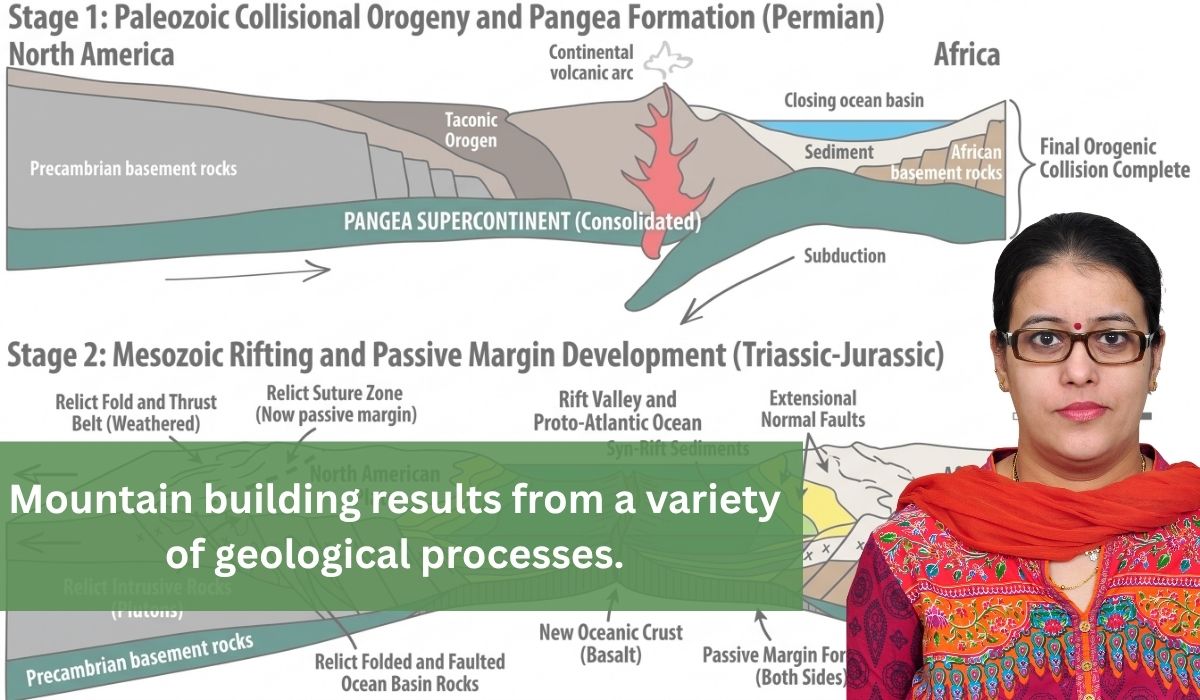
Mountain building (orogenesis) has evolved significantly from early vertical-movement paradigms to highly integrated horizontal and deep-mantle models. While classical concepts like Kober’s Geosynclinal Theory and Jeffreys’ Thermal Contraction laid the early groundwork, contemporary geomorphology explains mountain building through the Plate Tectonic framework and several recent additions involving mantle dynamics and climate-tectonic coupling.
The Foundational Framework: Plate Tectonics Theory
In contemporary plate tectonics, mountain building is recognized as polygenetic. While convergent zones produce the grandest planetary folds (orogens), divergent boundaries construct the Earth’s primary volcanic relief via thermal expansion and crustal extension, and transverse boundaries act as localized tectonic engines, transforming lateral displacement into rapid, high-angle structural uplifts through transpression.
Convergent Plate Boundaries
Divergent Plate Boundaries
At divergent boundaries, plates pull apart under tensional stress. While this crustal thinning creates low-lying rifts, it simultaneously generates massive mountain systems through two primary mechanisms: Thermal Buoyancy and Fault-Block Tectonics.
Transverse Plate Boundaries
Recent and Refined Concepts in Orogenesis
To address anomalies that basic plate tectonics cannot fully explain—such as rapid late-stage uplift or intraplate mountains—geologists have introduced several advanced modern theories:
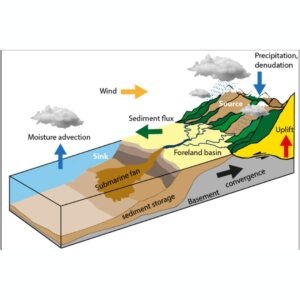
Modern geomorphologists (e.g., Peter Zeitler, Beaumont) have broken the old assumption that endogenic (internal) and exogenic (external) forces operate completely independently.
The Concept: Heavy atmospheric precipitation on the windward slopes of a rising mountain causes aggressive fluvial or glacial erosion. This rapid localized denudation unloads immense weight from the crust, triggering a rapid isostatic rebound (uplift).
Lithospheric Delamination (Convective Thinning)
During prolonged continental collisions, the underlying root of the mountain becomes incredibly thick and dense due to high-pressure metamorphism.
The Concept: Because this cold crustal root becomes denser than the underlying asthenosphere, it becomes unstable, breaks away, and peels/sinks into the deeper mantle.
Terrane Accretion (Accretionary Orogeny)
Instead of viewing orogeny strictly as the collision of two massive, uniform continents, recent theories highlight the incremental stitching of the crust.
Dynamic Topography and Mantle Plumes
This theory accounts for broad vertical uplifts that happen far away from active plate boundaries.
Flexural Isostasy Model
Moving past the simplistic, independent vertical column models of Airy and Pratt, modern views treat the lithosphere as a continuous, elastic sheet. When tectonic forces pile heavy rock sheets (thrust loads) onto a continent, the lithosphere bends under the weight. This flexure explains the simultaneous uplift of the mountain core and the structural sagging right next to it, which creates deep foreland basins (such as the Indo-Gangetic trough parallel to the rising Himalayas).
Analytical Conclusion
In a modern geomorphological context, mountain building is no longer viewed as a closed, purely mechanical endogenic event. It is written about in answer writing as a holistic Earth System process—a dynamic equilibrium where deep mantle convection currents, horizontal plate boundary interactions, elastic lithospheric flexure, and surface sub-aerial denudation continuously feed into one another to engineer the Earth’s relief.