Tag Archives: Geography and Environment

Neetu Singh Geography

Discuss the mechanism and origin of Monsoon

Discuss the mechanism and origin of Monsoon winds and explain the role of El Nino on Monsoon circulation.

Introduction The Indian Monsoon is a seasonal reversal of winds driven by complex thermal and pressure gradients. Rather than a single local event, it is a global atmospheric phenomenon involving the interaction between land, ocean, and the upper-tropospheric circulation. Its origin is explained by two primary schools of thought: the Classical (Thermal) theory and the Modern (Dynamic) theory.

Mechanisms and Origin of Monsoon Winds

The Classical Theory (Edmond Halley)

This theory views the monsoon as a giant land-sea breeze.

  • Summer Monsoon: During summer, the sun is overhead the Tropic of Cancer. The vast landmass of Asia (specifically the Tibetan Plateau) heats up intensely, creating a low-pressure zone. Simultaneously, the Indian Ocean remains relatively cooler (high pressure). Air moves from the high-pressure ocean to the low-pressure land, bringing moisture-laden winds.
  • Winter Monsoon: The process reverses in winter as the sun moves to the Tropic of Capricorn. The land cools rapidly (high pressure), while the ocean retains heat longer (low pressure), causing winds to blow from land to sea.

The Modern Theory (Dynamic)

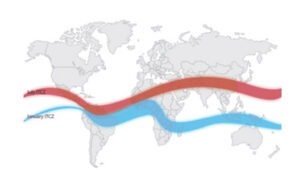
Modern meteorology attributes the monsoon to the seasonal migration of planetary pressure and wind belts, specifically the Inter-Tropical Convergence Zone (ITCZ).

Shift of the ITCZ: During the summer, the ITCZ shifts north of the equator to create  Monsoon Trough. This draws the southeast trade winds across the equator. As they cross, the Coriolis force deflects them to the right, transforming them into the Southwest Monsoon.

The Role of Jet Streams:

  • Tropical Easterly Jet (TEJ): In summer, a powerful easterly jet stream flows at high altitudes (near the tropopause) from East to West over the Indian peninsula. It is believed to assist in the “pumping” of air, intensifying the low-pressure system over the Indian subcontinent, thereby strengthening the monsoon.
  • Sub-Tropical Westerly Jet (STWJ): During winter, the STWJ blows south of the Himalayas. For the monsoon to set in (summer), this jet must retreat northwards (tibetan plateau heating is a catalyst for this shift).

The Role of El Niño on Monsoon Circulation

El Niño is a periodic warming of the sea surface temperatures (SST) in the central and eastern equatorial Pacific Ocean, which disrupts the normal Walker Circulation and acts as a major atmospheric “spoiler” for the Indian Monsoon.

Mechanism of Disruption

  1. Normal Conditions (Walker Circulation): Under normal conditions, strong trade winds push warm water toward the Western Pacific (near Indonesia/Australia). This creates a low-pressure area (warm, rising air) in the west and a high-pressure area (cool, sinking air) in the east. This helps maintain the monsoon moisture transport toward India.
  2. El Niño Conditions: The trade winds weaken or reverse. Warm water surges toward the South American coast. The convective “rising air” center shifts from the Western Pacific toward the Central/Eastern Pacific.
  3. Impact on India: This shift triggers a descending (subsiding) air limb over the Indian Ocean and the Indian subcontinent. High-pressure conditions over India inhibit the moist convection required for rainfall, leading to weak monsoon performance, drought, or delayed onset.

The ENSO-Monsoon Link

  • Teleconnections: The atmosphere acts as a bridge. The change in Pacific heating alters the global pressure distribution, which pushes the Tibetan High (the upper-air high-pressure cell that drives the monsoon) out of position or weakens it.
  • Inverse Correlation: Historically, strong El Niño years have frequently correlated with sub-par rainfall in India. However, the correlation is not always linear, as other factors like the Indian Ocean Dipole (IOD) can sometimes offset the negative impacts of El Niño.

  Supplementary Factors: IOD and MJO

While El Niño is a major driver, the monsoon is also modulated by:

  • Indian Ocean Dipole (IOD): A “positive” IOD (warmer western Indian Ocean relative to the east) can act as a buffer against El Niño, effectively “pulling” the monsoon toward India even when Pacific conditions are unfavorable.
  • Madden-Julian Oscillation (MJO): An eastward-moving pulse of cloud and rainfall near the equator that can bring “active” and “break” phases to the monsoon cycle on a 30-60 day timescale.

Conclusion The Indian Monsoon is a highly resilient but sensitive system. While the origin of the monsoon is fundamentally tied to the thermal heating of the Tibetan Plateau and the shifting of the ITCZ, its variability is governed by complex global teleconnections. El Niño serves as a primary disruptor of the atmospheric circulation, proving that the rainfall in rural India is deeply interconnected with the ocean-atmospheric dynamics of the distant Pacific.

Explain the causes of glacial lake outburst flood.

Explain the causes of glacial lake outburst flood. 2025

A glacial lake outburst flood (GLOF) is a release of meltwater from a moraine- or ice-dam glacial lake due to dam failure. GLOFs often result in catastrophic flooding downstream, with major geomorphic and socioeconomic impacts.

GLOFs have three main features:

  • They involve sudden (and sometimes cyclic) releases of water.
  • They tend to be rapid events, lasting hours to days.
  • They result in large downstream river discharges (which often increase by an order of magnitude).

Some of the largest floods in Earth’s history have been GLOFs. They have caused large-scale landscape change, and even altered regional climate by releasing huge quantities of freshwater to the oceans.

Today, GLOFs pose a risk downstream communities and infrastructure. In Peru alone, GLOFs were responsible for ~32,000 deaths in the 20th century. They have killed hundreds to thousands of people in other mountain regions (e.g. the Himalayas), and destroyed roads, bridges, and hydroelectric developments.

An increasing hazard

Importantly, the general global trend of glacier shrinkage through the 20th and 21st centuries has seen the number and size of glacial lakes increase, at the same time as human activities have expanded further into glaciated catchments. The study of how GLOFs occur and their impacts is therefore important for future hazard mitigation.

Glacial lake settings

There are two main settings in which glacial lakes form: (1) behind moraine dams, and (2) behind ice dams.

Moraine-dammed lakes

Moraine-dammed lakes form during periods of glacier retreat from a moraine. As a glacier margin retreats, water collects in the topographic low between the ice-front and the abandoned frontal and/or lateral moraine. Most existing moraine-dammed lakes (such as the Imja Tsho glacial lake in Nepal formed when mountain glaciers began to retreat from large moraine ridges constructed during the Little Ice Age

Moraine-dam failures

The failure of glacier and moraine dams depends on two main factors: (1) the integrity of the dam, and (2) the nature of trigger mechanisms

Moraine dams tend to be narrow and sharp-crested. As such, they are more likely to fail than broader dam types, such as ice-contact fans or landslides Most moraines are made up of loose, poorly sorted, permeable sediment, and some contain ice cores. Unconsolidated sediments are susceptible to failure, especially if saturated, while the melting of ice cores may cause moraines to subside over time. Despite these weaknesses, where a moraine is low, wide, and armoured by large rock material it may survive intact for hundreds or even thousands of years.

Displacement waves

Outburst floods in moraine-dammed settings are often caused by the sudden input of material into a lake causing displacement of water and overtopping of the dam. Displacement (or seiche) waves are commonly triggered by avalanches or rockfalls, or calving of a lake-terminating glacier.

Other triggers include, the rapid input of meltwater from an glacier upstream, heavy rainfall or snowmelt events that rapidly raise the lake level, or earthquakes that destabilise the moraine dam