
Critically examine the theories of industrial location
Ans. In understanding present-day industrial locational decisions, three fundamental approaches to the problem of plant location proposed are considered – least cost theory, locational interdependence theory, and profit-maximization approaches – and the different conclusions they reach.
Least-Cost Theory
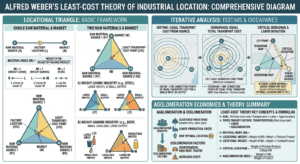
The classical model of industrial location theory, the least-cost theory, is based on the work of Alfred Weber (1868-1958) and sometimes called Weberian analysis. It explains the optimum location of a manufacturing establishment in terms of minimization of three basic expenses: relative transport costs, labor costs, and agglomeration costs. Agglomeration refers to the clustering of productive activities and people for mutual advantage. Such clustering can produce “agglomeration economies” through shared facilities and services. Diseconomies such as higher rents or wage levels resulting from competition for these resources may also occur. Weber concluded that transport costs are the major consideration determining location. That is, the optimum location will be found where the costs of transporting raw materials to the factory and finished goods to the market are at their lowest. He noted, however, if variations in labor or agglomeration costs are sufficiently great, a location determined solely on the basis of transportation costs may not in fact be the optimum one. Weber made five controlling assumptions:
(1) An area is completely uniform physically, politically, culturally, and technologically. This is known as the uniform, or isotropic, plain assumption.
(2) Manufacturing involves a single product to be shipped to a single market whose location is known.
(3) Inputs involve raw materials from more than one known source location.
(4) Labour is infinitely available but immobile in location.
(5) Transportation routes are not fixed but connect origin and destination by the shortest path; and transport costs directly reflect the weight of items shipped and the distance they are
moved.https://www.youtube.com/channel/UCINzglszT5_M6AVYkoWfkLQ?view_as=subscriber
Given these assumptions, Weber derived the least transport cost location by means of the locational triangle. It diagrams the cost consequences of fixed locations of materials and market and of movement in any direction of a given weight of commodity at a uniform cost per unit of distance. Weberian analysis, however, aims at the least transport cost location, which most likely will be an intermediate point somewhere within the locational triangle. Its exact position will depend on distances, the respective weights of the raw material inputs, and the final weight of the finished product, and may be either material or market oriented. Material orientation reflects a sizeable weight loss during the production process; market orientation indicates a weight gain.
Locational Interdependence Theory
When the locational decision of one firm is influenced by locations chosen by its competitors, a condition of locational interdependence exists. It influences the manner in which competitive firms with identical cost structures arrange themselves in space to assure themselves a measure of spatial monopoly in their combined market. In locational interdependence theory, the concern is with variable revenue analysis rather than, as in the Weber model, with variable costs. The simplest case concerns the locational decisions of two firms in competition with each other to supply identical goods to customers evenly spaced along a linear market. The economist Harold Hotelling (1895-1973), who is usually associated with the locational interdependence approach, expanded the conclusion about clustered ice cream sellers to a more generalized statement explaining industrial concentration by multiple producers under conditions of identical production costs and inelastic market demand. However, if the market becomes sensitive to price, sales to more distant customers will be discouraged and producers seeking to maximize sales will again separate rather than aggregate. The conclusion then is that price sensitivity (elasticity of demand) will encourage industrial dispersion.
Profit-Maximization Approaches
For many theorists, the simplicities and rigidities of the least-cost and the locational interdependence explanations are unrealistically restrictive. Ultimately, they maintain, the correct location of a production facility is where the net profit is greatest. They propose employing a substitution principle that recognizes that in many industrial processes, it is possible to replace a declining amount of one input (e.g. labor) with an increase in another (e.g. capital for automated equipment) or to increase transportation costs while simultaneously reducing land rent. With substitution, a number of different points may be appropriate manufacturing locations. Further, they suggest, a whole series of points may exist where total revenue of an enterprise just equals its total cost of producing a given output. These points, connected, mark the spatial margin of profitability and define the larger area within which profitable operation is possible. Location anywhere within the margin assures some profit and tolerates both imperfect knowledge and personal (rather than economic) considerations. Such less-than-optimal, but still acceptable, sites are considered satisficing locations.
For some firms, spatial margins may be very broad because transport costs are a negligible factor in production and marketing. Such firms are said to be footloose – that is, neither resource nor market oriented. For example, both the raw materials and the finished product in the manufacture of computers are so valuable, light, and compact that transportation costs have little bearing on where production takes place. Other Locational Considerations and Controls : The behavior of individual firms seeking specific production sites under competitive commercial conditions forms the basis of most classical industrial location theory. But such theory no longer fully explains world or regional patterns of industrial localization or specialization. Moreover, it does not account for locational behavior that is uncontrolled by objective “factors,” influenced by new production technologies and corporate structures, or directed by noncapitalistic planning goals.
Traditional theories (including many variants not reviewed here) sought to explain location decisions for plants engaged in mass production for mass markets where transportation lines were fixed and transport costs relatively high. Both conditions began to change significantly during the last years of the 20th century. Assembly line production of identical commodities by a rigidly controlled and specialized labor force for generalized mass markets – known as “Fordism” to recognize Henry Ford’s pioneering development of the system – became less realistic in both market and technology terms. In its place, post-Fordist flexible manufacturing processes based on smaller production runs of a greater variety of goods aimed at smaller, niche markets than were catered to by traditional manufacturing have become common. At the same time, information technology applied to machines and operations, increasing flexibility of labor, and declining costs for transportation services that were increasingly viewed from a cost-time rather than a cost-distance standpoint have materially altered underlying assumptions of the classical theories.