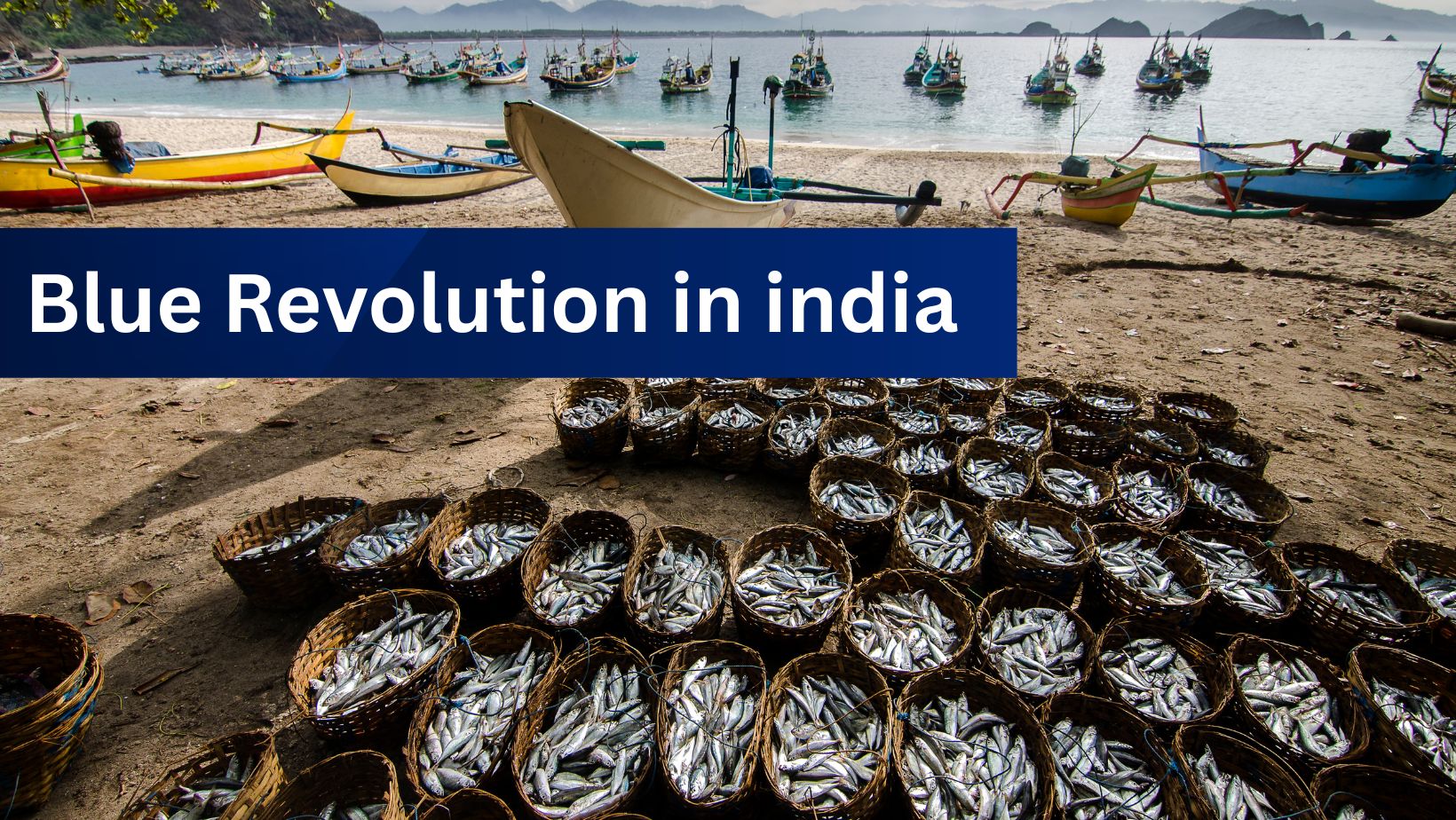
The Pradhan Mantri Matsya Kisan Samridhi Sah-Yojana (PM-MKSSY) represents a major policy shift aimed at stabilizing India’s booming aquaculture sector by protecting small and marginal farmers against devastating financial risks like disease, natural calamities, and pollution.
Here is a breakdown of the sector’s current scale, the inherent risks, and how the PM-MKSSY insurance initiative operates.
India’s fisheries sector has transformed into a critical engine for rural economic mobility, showing massive growth over the last decade:
Global Standing: India is the world’s second-largest fish producer, holding roughly an 8% global share.
Production: Total fish production hit a record 19.8 million tonnes in 2024–25 (up from 9.6 million tonnes in 2013–14). Aquaculture now accounts for ~74% of this total.
Exports: Seafood exports reached USD 8.46 billion in 2025–26, with frozen shrimp driving nearly 66% of total export earnings.
Livelihoods: The sector supports over 30 million people, primarily from coastal, tribal, and economically marginalized communities.
Untapped Potential: Despite an average productivity rise to 4.77 tonnes per hectare, only about 17% of India’s available brackish water areas and vast inland water bodies have been developed for aquaculture.
As the sector scales horizontally (new farms) and vertically (intensification), farmers face increasing exposure to diseases, pollution, summer kills, and climate-driven natural disasters (floods, cyclones). Because small and marginal farmers operate on thin margins—often relying on high-interest informal credit—a single failed crop cycle can trigger an irreversible debt spiral. Insurance serves not to prevent the loss, but to prevent the ensuing financial collapse.
Approved in February 2024, the PM-MKSSY scheme directly addresses the affordability of insurance premiums. Benefits are delivered directly to farmers via Direct Benefit Transfer (DBT) through the National Fisheries Digital Platform (NFDP).
The government provides a one-time incentive of up to 40% of the insurance premium cost for one crop cycle.
| System Type | Maximum Subsidy Limit | Area / Size Constraints |
| Pond-Based Aquaculture | Up to ₹25,000 per hectare (Max ₹1,00,000) | Covers up to 4 hectares (pro-rata for farms <1 hectare). |
| Advanced Systems (Cage Culture, RAS, Bio-floc, Raceways) | Up to ₹1,00,000 | Maximum eligible unit size of 1,800 cubic metres. |
Special Category Bonus: Scheduled Caste (SC), Scheduled Tribe (ST), and women beneficiaries receive an additional 10% incentive over the general category rates.
To build trust and ensure the system is more than just paperwork, the scheme mandates strict timelines for payouts once a loss assessor evaluates the documented damages:
30 days maximum turnaround for shrimp culture claims.
45 days maximum turnaround for all other aquaculture activities.
Current Rollout:
Four public insurers—OICL, AICL, NIAL, and UIIC—are currently operational, with private insurers being onboarded. Early implementation has seen 316 applications covering 730.61 hectares. To date, 127 applications have been successfully approved and disbursed, delivering ₹40.03 lakh in benefits across 321.74 hectares.
The ultimate goal of PM-MKSSY is to transition aquaculture insurance from a state-subsidized intervention into a self-sustaining, durable market where risk protection is viewed as a standard, reliable component of farm management.