Discuss the mechanism and origin of Monsoon

17
Jun
Discuss the mechanism and origin of Monsoon winds and explain the role of El Nino on Monsoon circulation.
Introduction The Indian Monsoon is a seasonal reversal of winds driven by complex thermal and pressure gradients. Rather than a single local event, it is a global atmospheric phenomenon involving the interaction between land, ocean, and the upper-tropospheric circulation. Its origin is explained by two primary schools of thought: the Classical (Thermal) theory and the Modern (Dynamic) theory.
Mechanisms and Origin of Monsoon Winds
The Classical Theory (Edmond Halley)
This theory views the monsoon as a giant land-sea breeze.
- Summer Monsoon: During summer, the sun is overhead the Tropic of Cancer. The vast landmass of Asia (specifically the Tibetan Plateau) heats up intensely, creating a low-pressure zone. Simultaneously, the Indian Ocean remains relatively cooler (high pressure). Air moves from the high-pressure ocean to the low-pressure land, bringing moisture-laden winds.
- Winter Monsoon: The process reverses in winter as the sun moves to the Tropic of Capricorn. The land cools rapidly (high pressure), while the ocean retains heat longer (low pressure), causing winds to blow from land to sea.
The Modern Theory (Dynamic)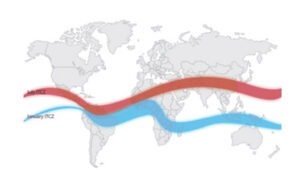
Modern meteorology attributes the monsoon to the seasonal migration of planetary pressure and wind belts, specifically the Inter-Tropical Convergence Zone (ITCZ).
Shift of the ITCZ: During the summer, the ITCZ shifts north of the equator to create Monsoon Trough. This draws the southeast trade winds across the equator. As they cross, the Coriolis force deflects them to the right, transforming them into the Southwest Monsoon.
The Role of Jet Streams:
- Tropical Easterly Jet (TEJ): In summer, a powerful easterly jet stream flows at high altitudes (near the tropopause) from East to West over the Indian peninsula. It is believed to assist in the “pumping” of air, intensifying the low-pressure system over the Indian subcontinent, thereby strengthening the monsoon.
- Sub-Tropical Westerly Jet (STWJ): During winter, the STWJ blows south of the Himalayas. For the monsoon to set in (summer), this jet must retreat northwards (tibetan plateau heating is a catalyst for this shift).
The Role of El Niño on Monsoon Circulation
El Niño is a periodic warming of the sea surface temperatures (SST) in the central and eastern equatorial Pacific Ocean, which disrupts the normal Walker Circulation and acts as a major atmospheric “spoiler” for the Indian Monsoon.
Mechanism of Disruption
- Normal Conditions (Walker Circulation): Under normal conditions, strong trade winds push warm water toward the Western Pacific (near Indonesia/Australia). This creates a low-pressure area (warm, rising air) in the west and a high-pressure area (cool, sinking air) in the east. This helps maintain the monsoon moisture transport toward India.
- El Niño Conditions: The trade winds weaken or reverse. Warm water surges toward the South American coast. The convective “rising air” center shifts from the Western Pacific toward the Central/Eastern Pacific.
- Impact on India: This shift triggers a descending (subsiding) air limb over the Indian Ocean and the Indian subcontinent. High-pressure conditions over India inhibit the moist convection required for rainfall, leading to weak monsoon performance, drought, or delayed onset.
The ENSO-Monsoon Link
- Teleconnections: The atmosphere acts as a bridge. The change in Pacific heating alters the global pressure distribution, which pushes the Tibetan High (the upper-air high-pressure cell that drives the monsoon) out of position or weakens it.
- Inverse Correlation: Historically, strong El Niño years have frequently correlated with sub-par rainfall in India. However, the correlation is not always linear, as other factors like the Indian Ocean Dipole (IOD) can sometimes offset the negative impacts of El Niño.
Supplementary Factors: IOD and MJO
While El Niño is a major driver, the monsoon is also modulated by:
- Indian Ocean Dipole (IOD): A “positive” IOD (warmer western Indian Ocean relative to the east) can act as a buffer against El Niño, effectively “pulling” the monsoon toward India even when Pacific conditions are unfavorable.
- Madden-Julian Oscillation (MJO): An eastward-moving pulse of cloud and rainfall near the equator that can bring “active” and “break” phases to the monsoon cycle on a 30-60 day timescale.
Conclusion The Indian Monsoon is a highly resilient but sensitive system. While the origin of the monsoon is fundamentally tied to the thermal heating of the Tibetan Plateau and the shifting of the ITCZ, its variability is governed by complex global teleconnections. El Niño serves as a primary disruptor of the atmospheric circulation, proving that the rainfall in rural India is deeply interconnected with the ocean-atmospheric dynamics of the distant Pacific.
Go Back